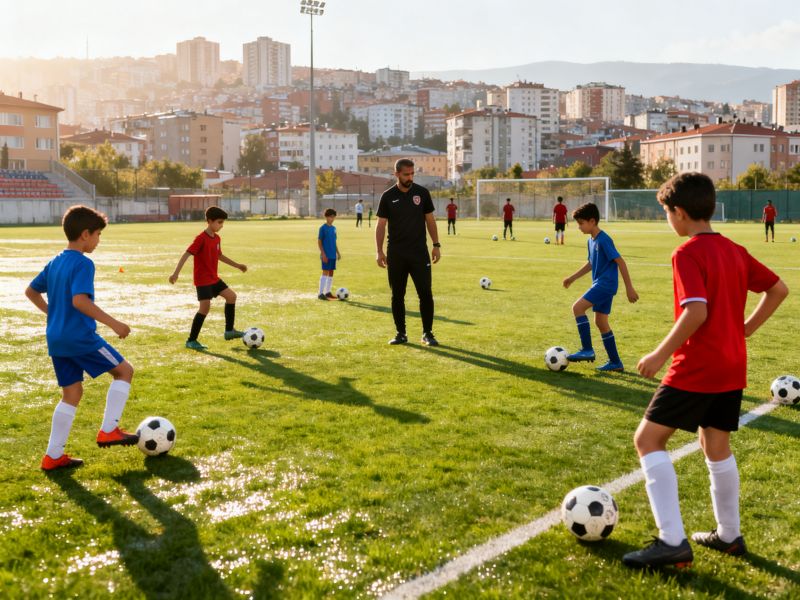
Bursa rarely tops lists of Turkey's sporting capitals. Istanbul dominates the headlines。Ankara hosts the national stadium, and Izmir claims the Aegean spirit. Yet Bursa Sports has quietly built something more durable: a regional identity where football, basketball, and wrestling overlap with a manufacturing base that produces equipment for half the country's amateur leagues. Walk through the Görükle campus of Uludağ University on a Tuesday afternoon and you'll see it — students playing three-on-three near the cafeteria, a fencing club practicing in a converted warehouse, and coaches from the local youth academy scouting a sixteen-year-old winger who already draws comparisons to Arda Güler. That's not marketing copy. It's a typical scene.Bursaspor's 2010 Süper Lig title remains the city's defining sporting memory, but it also created a false ceiling. Fans still talk about that season as if it happened last spring. The club's subsequent financial collapse and relegation battles forced a reckoning — one that pushed resources toward grassroots development. I spent an afternoon at a facility in Nilüfer where kids as young as seven rotate through stations: agility ladders, wall passes, and small-sided games on a pitch that doubles as a parking lot on weekends. The head coach。a former third-division midfielder named Emre, told me the club now tracks every player's minutes and growth data from age nine. That level of record-keeping was unheard of here a decade ago. Bursa Sports, in this sense, is less about trophies and more about infrastructure.Basketball tells a different story. Tofaş has been a fixture in the Turkish league since the 1970s, and its youth academy has produced NBA-caliber talent like Cedi Osman. The team's arena, a 7,500-seat bowl on the city's western edge, sells out for derbies against Fenerbahçe but sits half-empty on a Wednesday against a mid-table opponent. That unevenness frustrates the front office. Still。the club's community programs — free clinics in twelve public schools last year — have widened the pipeline. A local physical education teacher, Ayşe, mentioned that half her fifth-grade class now lists basketball as their favorite sport. Ten years ago, it was football or nothing.Wrestling deserves its own paragraph. Bursa has produced Olympic medalists in Greco-Roman wrestling, and the city's older generation still gathers in tea houses to debate grip techniques with the intensity of football pundits. The sport's local federation runs a small museum near the Setbaşı bridge, and on a rainy Friday I watched a group of teenagers practice neck bridges and par terre drills for two hours without a single complaint. No phones. No music. Just the sound of bodies hitting the mat. That discipline hasn't translated into mass popularity, but it has shaped Bursa Sports' reputation for toughness — a label that college recruiters from Istanbul have started to notice.The real test for Bursa Sports is whether it can keep talent from leaving. Every promising teenager I spoke to mentioned Istanbul as the end goal. The city's sports director, a wiry man named Kemal, admitted that retention is the hardest problem. He pointed to a new partnership with local factories that offers apprenticeships to athletes who stay through high school. It's a small program, maybe forty kids. But it signals a shift: treating sports not as a pipeline to elsewhere but as a reason to stay. That's a harder sell than a championship banner. It's also more likely to last.