
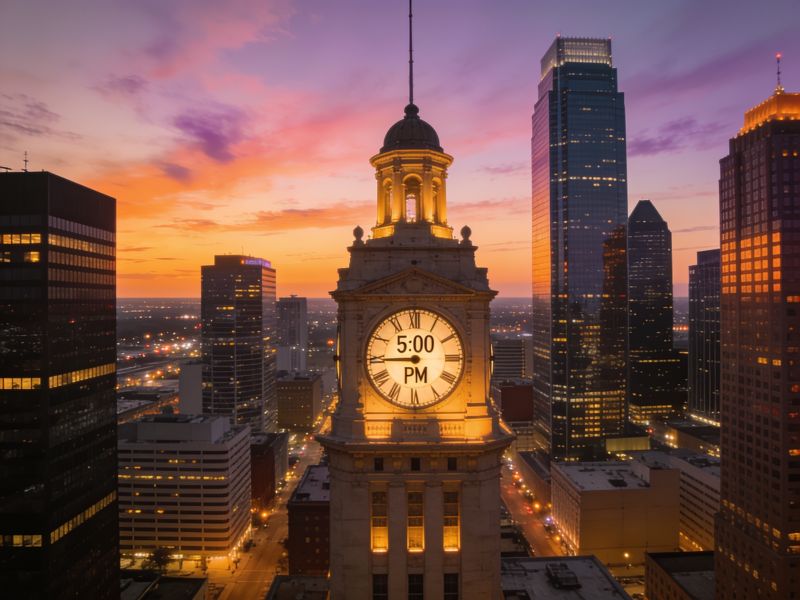
Dallas clocks read 3:47 p.m. on a Tuesday in January while Chicago shows the same minute and Denver sits an hour behind. That’s not a coincidence—it’s the daily reality of Dallas time, USA, which follows Central Standard Time (CST, UTC−6) from November to March and Central Daylight Time (CDT, UTC−5) for the rest of the year. The switch happens at 2 a.m. on the second Sunday of March and the first Sunday of November。aligning with most of Texas except El Paso and a few western counties that stick to Mountain Time.I’ve watched the practical effects of Dallas time on business calls. A client in Los Angeles schedules a 9 a.m. meeting and expects Dallas participants to be available—but 9 a.m. Pacific is 11 a.m. in Dallas, a two-hour gap that catches people off guard. Flip it: a 4 p.m. Dallas conference call lands at 2 p.m. in Los Angeles, still workable but tight for West Coast commuters. New York sits one hour ahead。
so a 10 a.m. Dallas start is already 11 a.m. for Manhattan, which explains why many Dallas firms push morning meetings to 8 a.m. local time. That single hour matters more than most people admit.Daylight saving in Dallas time adds another layer. When the U.S. springs forward in March, Dallas jumps from 1:59 a.m. CST to 3:00 a.m. CDT—skipping the 2 a.m. hour entirely. For a few weeks each year。Dallas is five hours behind London instead of six, which briefly reshuffles international calls. I once scheduled a Thursday call with a London team for 3 p.m. Dallas time, assuming a six-hour gap. It was actually five, so they were still at dinner. Now I check the offset every March and November without exception.Dallas time, USA。also shapes local routines in ways outsiders miss. Sunrise in mid-December lands around 7:20 a.m. CST, while sunset comes at 5:24 p.m.—short days that push outdoor runs to lunch breaks. In June, the sun is up before 6:20 a.m. and doesn’t set until nearly 8:40 p.m. CDT, giving families long evenings at White Rock Lake. The airport runs on Dallas time too: DFW’s busiest departure bank hits between 7 and 9 a.m. local, and a 6 a.m. flight means leaving downtown at 4:30 a.m.—a detail that surprises anyone used to a later sunrise.
For anyone coordinating with Dallas, the safest habit is to write “3 p.m. CST” or “3 p.m. CDT” explicitly rather than just “Dallas time” I’ve seen a missed deadline because someone assumed CST in July—when Dallas was actually on CDT—and showed up an hour late. The clock itself is simple. The consequences of ignoring its seasonal shift are not.